
The Portfolio Problem: Why GPS Compliance Doesn't Scale With Your Portfolio

Managing one renewable asset is challenging. Managing ten is exponentially harder.
Each plant has unique GPS compliance requirements. Different connection points. Different performance characteristics. Different compliance obligations. The list of things to track grows with every new site — and the connections between them aren't always obvious until something goes wrong.
Most asset managers we work with lack a unified view of compliance health across their portfolio. Critical issues at one site get buried by the volume of data coming from the others. Teams spend more time hunting for information than acting on it. The frustration we hear most often isn't about technical complexity — it's about the inability to answer a simple question:
"Which of my assets needs attention today?"
The In-House Trap
It's tempting to solve this internally. Most operators start there. A spreadsheet, a SharePoint folder, a SCADA historian query, a few clever scripts written by a senior engineer who understands the GPS inside out. For a single plant, this can work reasonably well.
The trouble starts when the portfolio changes — and renewable portfolios almost always change.
Portfolios grow. A new project comes online and the existing toolkit needs to be extended. Different metering. Different SCADA tags. Different naming conventions. The "system" that worked for three plants now needs to work for seven, and the engineer who built it has other things to do.
Portfolios change hands. Acquisitions and divestments are now routine in the Australian market. Each transaction brings a new set of compliance records, often in unfamiliar formats, sometimes incomplete, occasionally inherited from a developer who is no longer reachable. The acquiring team has to rebuild context from scratch — and the AER doesn't grant a grace period while they do.
Portfolios diversify. A pure solar operator adds a wind farm. A wind operator co-locates batteries. A developer commissions a hybrid plant. Each of these brings genuinely different technical behaviour, and the GPS clauses that matter most are different too. A wind farm's voltage droop response involves synchronised data from the connection point meter and the turbine SCADA. A BESS faces ride-through and frequency response obligations that look nothing like a synchronous generator's. A hybrid site combines several of these, and the registered performance standards for each component need to be assessed against the right signals at the right resolution.
This is the part that catches teams out: the GPS itself is project-specific. Two solar farms a hundred kilometres apart can have materially different registered performance standards because they negotiated different connection agreements at different times under different versions of the NER. Codifying those differences once is hard. Maintaining that codification across a growing, mixed-technology portfolio — through staff turnover, regulatory updates, and asset transactions — is where in-house solutions tend to break.
Even with good tooling, the work doesn't go away. It just gets more expensive: more engineering hours, more bespoke configuration, more institutional knowledge concentrated in fewer heads. And as the AER's 2024–25 enforcement priorities have made clear, "we're working on it internally" isn't a position any compliance team wants to be defending.
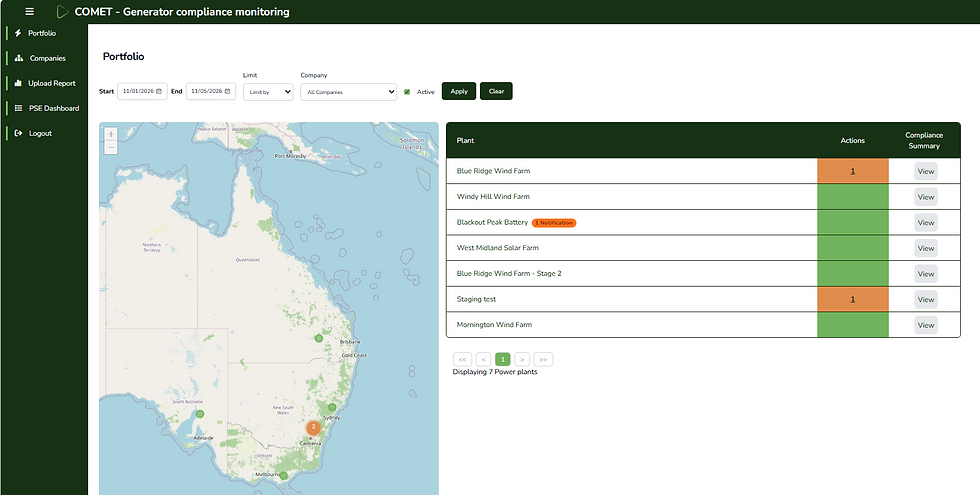
The Single View of GPS Compliance
We built COMET because we believe asset owners should be able to focus their engineering time on engineering — not on data hunting, format wrangling, or rebuilding compliance context every time the portfolio shifts.
COMET provides one dashboard showing real-time compliance status across your entire portfolio. It immediately identifies plants requiring action, regardless of whether they're solar, wind, BESS, or hybrid. Each plant's registered GPS is digitised and codified once, against its specific clauses, and assessed automatically as new data arrives. Centralised workflows make sure nothing falls through the cracks — and when assets change hands, the compliance history goes with them in a form that the new operator can actually use.
Your compliance risk shouldn't scale linearly with your portfolio size. With the right system of record underneath it, it doesn't have to.
COMET is in use across more than two dozen generation and storage assets in the NEM, covering over 3 GW under management. If you'd like to see how it handles your portfolio's mix of technologies and GPS requirements, let's have a conversation.

